Can a Small DNA Sequencer Give You Your Own Genome?
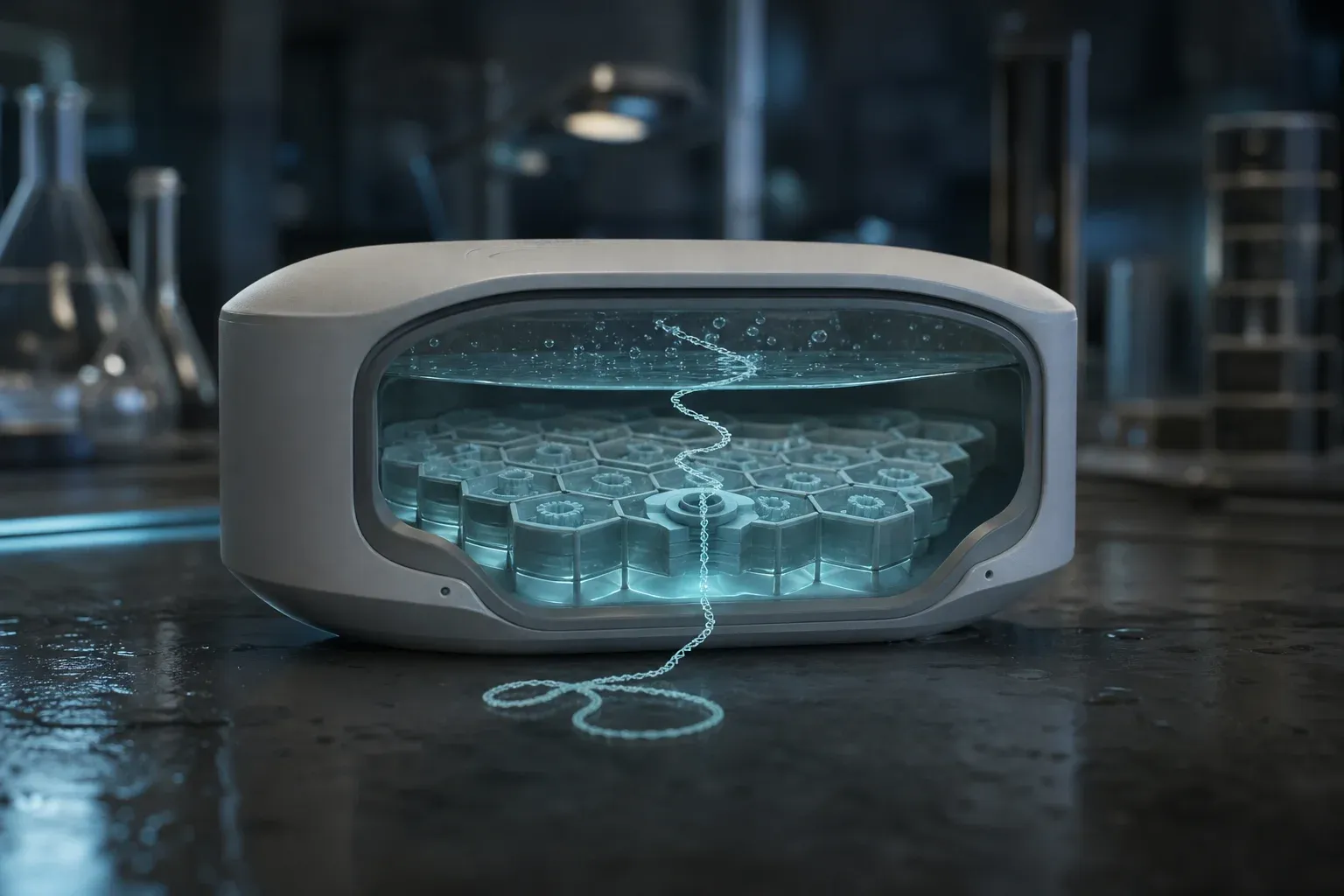
Yes, you can buy a DNA sequencer that fits in your hand, plug it into a laptop, and sequence your own DNA at home. The Oxford Nanopore MinION is the only serious option at that size, and it works. What it will not do is hand you a 30x human genome for the price of the device. A single MinION flow cell yields roughly 10 to 30 gigabases of sequence in a 72-hour run, and a human genome at 30x coverage needs about 90 gigabases, so you are looking at three or more flow cells per genome, plus high-molecular-weight DNA extraction, a fluorometer, a GPU for basecalling, and a few hundred gigabytes of storage per run. If your goal is a personal genome to analyze, a sequencing service is cheaper and more accurate. If your goal is to own the instrument and run targeted experiments, amplicons, mitochondrial DNA, methylation on a locus of interest, then a small sequencer is the right tool and the learning curve is worth it.
What “small sequencer” means in practice
Three device classes fit on a desk. The MinION (about 10 x 3 x 2 cm, USB-powered in the Mk1B configuration) uses nanopore sensing: a single DNA strand is pulled through a protein pore by a motor enzyme, and the ionic current across the pore is disturbed in a sequence-dependent way. The current trace is digitized at 4 or 5 kHz and converted to bases by a neural network. Because no amplification or optical detection is involved, read lengths are limited by the length of the molecule you managed to extract, routinely 10 to 50 kb and hundreds of kilobases with ultra-long protocols.
The Illumina MiniSeq is the benchtop short-read option. It is small for a sequencer but not portable, costs tens of thousands of dollars, and tops out around 7.5 Gb per run, which makes it unsuitable for whole human genomes and well suited to panels and small RNA-seq experiments. The third class is a capillary Sanger instrument, usually bought secondhand. Sanger reads one 700 to 900 bp fragment per capillary at very high per-base accuracy and remains the reference method for confirming a single variant. These three represent the generations of sequencing chemistry that arrived in sequence, each trading per-read accuracy against throughput 1, and the shift to massively parallel short reads is what made population-scale human genetics possible in the first place 2.
The actual requirements for a MinION run
Sample first. For the standard ligation kit (SQK-LSK114 on R10.4.1 chemistry) you want about 1 µg of high-molecular-weight genomic DNA in 47 µL, or 100 to 200 fmol of a shorter amplicon library. The rapid kit (SQK-RAD114) runs on roughly 400 ng and takes about 15 minutes, at the cost of shorter reads and lower yield. Ultra-long protocols ask for 40 µg, which in practice means fresh cells rather than a spit kit.
Extraction quality dominates everything downstream. A silica-column kit shears DNA to a median of 10 to 20 kb, which throws away the main advantage of the platform. Use a salting-out or magnetic-bead protocol (Monarch HMW, Nanobind, or a classic phenol-chloroform if you are set up for it) and check integrity on a TapeStation or a simple agarose gel. Quantify with a Qubit dsDNA fluorometer, not a NanoDrop: absorbance at 260 nm counts free nucleotides and RNA as if they were library, and a 2x overestimate will starve your flow cell. You also need a magnetic rack, a rotator, and heat blocks at 20°C, 37°C, and 65°C. No thermocycler is required for LSK114.
Then the run. Load the flow cell, check that it reports enough active pores (a healthy MinION flow cell starts above about 1,200 of 2,048 wells), and run MinKNOW. Write POD5 rather than FAST5 and basecall separately rather than live, because live basecalling at high accuracy will throttle the run on a laptop. A full MinION run produces on the order of hundreds of gigabytes of POD5 signal. The Flongle adapter and its smaller flow cells (about 1 to 2 Gb, under $100 each) exist for exactly this reason: they are the right way to learn the workflow without burning a full flow cell on a failed extraction.
Basecalling and analysis: the commands we would run
Basecall with Dorado in super-accuracy mode and emit methylation calls in the same pass, since the 5-methylcytosine signal is in the raw current and is lost if you discard it:
dorado basecaller sup,5mCG_5hmCG pod5/ --device cuda:0 > reads.bamSuper-accuracy basecalling is GPU-bound. A single consumer card (RTX 4090 class) will take most of a day for a full MinION run; CPU-only basecalling at sup is not practical. Align with minimap2 using the nanopore preset, keeping the methylation tags:
dorado aligner hg38.mmi reads.bam | samtools sort -o aln.bamor equivalently minimap2 -ax map-ont -y -t 16. Note that short-read aligners built on the Burrows-Wheeler transform, the tools that defined the previous decade of resequencing 3, are wrong for this data and will silently fail on 20 kb reads with 2% error. Call small variants with Clair3 using the model matched to your basecaller and chemistry, and call structural variants with Sniffles2 or cuteSV, which is where long reads earn their keep: deletions, insertions, inversions, and repeat expansions that short reads cannot span. Use whatshap or Clair3’s phasing output to get a phased, haplotype-resolved callset, and pair the phasing with the methylation calls if allele-specific methylation is of interest.
Expect SNV F1 above 99% in high-confidence regions at 30x with current chemistry, and materially worse performance on short insertions and deletions, especially in homopolymers and low-complexity repeats, where the current signal genuinely cannot distinguish 7 A’s from 8. This is the failure mode to internalize: your nanopore genome is excellent for structure and methylation, good for SNVs, and unreliable for indels. Coordinates and callsets are only comparable across datasets because the field standardized on shared reference assemblies and a common coordinate language 4, so always record the exact reference build (GRCh38 with or without alt contigs, or T2T-CHM13) alongside your VCF.
When to buy the device and when to buy the data
Buy the device if your interest is in running experiments. A MinION plus Flongle flow cells is the cheapest honest-to-goodness sequencing lab available, and it is a large part of why community and garage biology moved from culturing to sequencing over the past decade 5. Targeted work is where it shines: amplicon sequencing of a specific gene, full-length mitochondrial genomes, adaptive sampling to enrich a panel in silico during the run, 16S community profiling, or methylation over a promoter you care about.
Buy the data if you want an interpretable personal genome. Three MinION flow cells, extraction consumables, and your time will cost more than a 30x short-read genome from a service and will give you a less accurate small-variant callset, though a better structural one. The strongest position, and the one we take, is to get high-coverage short-read or HiFi data from a service as your reference-grade baseline, then keep a small sequencer for targeted follow-up. Also be clear-eyed about interpretation: reference panels and variant databases remain skewed toward European ancestry, so the annotation layer, rather than the sequencing, is often the limiting factor in what a variant means for you 6. Any finding you might act on belongs in front of a clinical geneticist with an accredited confirmatory test, because research-grade data from your own bench is not a diagnostic result.
Questions people also ask
How accurate is MinION sequencing? On R10.4.1 chemistry with super-accuracy basecalling, modal single-read accuracy is around Q20 to Q25, meaning roughly 99% to 99.7% of bases in a read are correct, with duplex reads reaching Q30. Consensus accuracy at 30x is far higher, but indel errors in homopolymers persist and do not fully average out with coverage.
How much DNA is required for sequencing? For nanopore ligation libraries, about 1 µg of genomic DNA; for the rapid kit, about 400 ng. Illumina library preps run from 1 ng to 500 ng depending on the kit. A 3 to 5 mL blood draw or a good saliva collection yields more than enough for either.
What is the minimum DNA concentration required for Sanger sequencing? Purified PCR products are typically submitted at 1 to 3 ng per 100 bp of amplicon (so roughly 10 to 30 ng for a 1 kb product), and plasmids at 200 to 500 ng per reaction, with primer at about 3 to 5 pmol.
What is Sanger sequencing versus NGS? Sanger reads one amplified fragment per capillary using dideoxy chain termination, giving 700 to 900 high-accuracy bases at high cost per base. Next-generation methods sequence millions to billions of fragments in parallel, trading read length and per-read accuracy for throughput 2. Earlier alternatives such as sequencing by hybridization to oligonucleotide arrays were explored for the same throughput problem and ended up serving genotyping rather than de novo sequencing 7.
What are the three types of DNA sequencing? Conventionally: Sanger capillary sequencing, short-read sequencing by synthesis (Illumina), and long-read single-molecule sequencing (nanopore and PacBio). Each generation solved the throughput or read-length limits of the one before it 1.
Oak builds longitudinal molecular profiles of individuals: whole-genome sequencing, RNA sequencing, proteomics, blood biomarkers, and continuous glucose data, integrated into one model of you. Build your profile.
Footnotes
-
Ivo Glynne Gut. DNA sequencing – spanning the generations. New Biotechnology, 2012. https://doi.org/10.1016/j.nbt.2012.08.030 ↩ ↩2
-
Elaine R. Mardis. The impact of next-generation sequencing technology on genetics. Trends in Genetics, 2008. https://doi.org/10.1016/j.tig.2007.12.007 ↩ ↩2
-
Ben Langmead, Cole Trapnell, Mihai Pop, et al. Ultrafast and memory-efficient alignment of short DNA sequences to the human genome. Genome Biology, 2009. https://doi.org/10.1186/gb-2009-10-3-r25 ↩
-
Maynard Olson, Leroy Hood, Charles Cantor, et al. A Common Language for Physical Mapping of the Human Genome. Science, 1989. https://doi.org/10.1126/science.2781285 ↩
-
Thomas Landrain, Morgan Meyer, Ariel Martin Perez, et al. Do-it-yourself biology: challenges and promises for an open science and technology movement. Systems and Synthetic Biology, 2013. https://doi.org/10.1007/s11693-013-9116-4 ↩
-
Sarah A. Tishkoff. 2025 ASHG presidential address: Stronger together: Advancing human genetics through the power of community. The American Journal of Human Genetics, 2026. https://doi.org/10.1016/j.ajhg.2026.02.013 ↩
-
Andrei D. Mirzabekov. DNA sequencing by hybridization — a megasequencing method and a diagnostic tool?. Trends in Biotechnology, 1994. https://doi.org/10.1016/0167-7799(94)90008-6 ↩